One-stop is one of the least precise phrases in fragrance sourcing. It can mean a factory that develops the scent, moulds the bottle, fills the unit and ships it, or a trading office that coordinates four subcontractors and calls the result a service. The difference shows up in lead times, accountability and cost, and it is usually visible within two questions if you know what to ask.
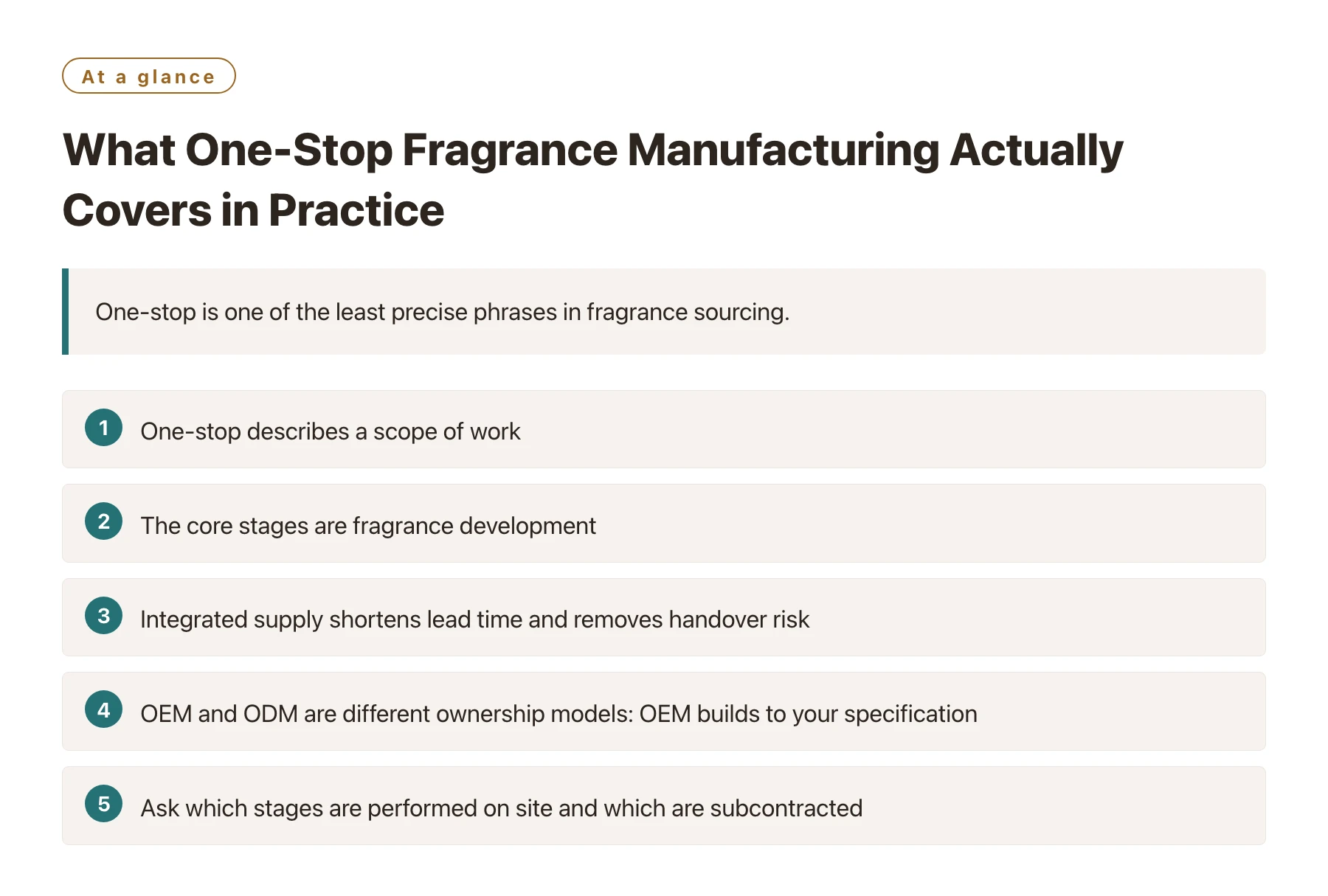
Key takeawaysOne-stop describes a scope of work, not a quality level, so the same phrase covers very different levels of integration. · The core stages are fragrance development, packaging sourcing, filling and quality documentation, and each one can be handled in house or outsourced. · Integrated supply shortens lead time and removes handover risk, while a coordinated network can offer wider component choice. · OEM and ODM are different ownership models: OEM builds to your specification, ODM offers a developed concept that you brand. · Ask which stages are performed on site and which are subcontracted, then ask who is accountable when a stage fails.
A buyer comparing three suppliers will often see the same words on all three websites: full service, one-stop solution, from concept to shelf. The vocabulary has become a category label rather than a description, which makes it useless for comparison.
The practical question is not whether a supplier offers everything. It is which parts of the chain they control directly, which parts they coordinate, and how the responsibility is divided when something goes wrong at a handover.
This breakdown sets out the real stages inside the phrase, how the two common operating models differ, and the questions that separate an integrated manufacturer from a well-organised middleman.
The five stages hidden inside the phrase
A finished fragrance product passes through five recognisable stages: brief and fragrance development, formula testing and compliance, packaging sourcing, filling and assembly, and documentation and shipping. A genuinely integrated supplier performs most of them under one roof.
Each stage has its own failure modes. Development fails when the brief is misunderstood. Compliance fails when restricted materials are not tracked. Packaging fails when a component arrives out of tolerance. Filling fails when the bulk batch does not match the approved reference. Documentation fails when nobody knows who holds which certificate.
Mapping your supplier against those five stages turns a vague claim into a checklist, and it usually reveals one stage where the chain is thinner than the marketing suggested.
Development and compliance belong together
Fragrance development and safety review are often treated as sequential, with the formula approved first and the paperwork handled afterwards. That order creates rework, because a material that fails a restriction forces a formula change, which restarts the sampling process.
Running both in parallel is much cheaper. The industry association that publishes the standards most formulators follow also describes how safety assessment sits inside normal development practice, which is a useful argument when a supplier wants to defer the review [1].
Packaging is where integration pays most
Bottles, closures and cartons come from different industries with different tolerances and lead times, and the interfaces between them are where most launch delays originate. When one party controls the container, the closure and the filling line, the fit is tested before the artwork is signed off.
Where packaging is coordinated rather than controlled, ask the supplier to name the factories involved and to describe how a rejected batch is handled. That answer matters more than a catalogue.
Testing closes the loop
Independent testing is the check on the whole chain. Third-party laboratories verify that what was specified is what was produced, and their reports are often the document a distributor or retailer asks for [2].
Even an integrated manufacturer benefits from an external report now and then, because it gives the buyer a verification path that does not depend on the supplier's own quality department.
Six questions that reveal the real scope of a supplier
- Which stages happen on your site?Ask for the list in order and mark which ones are performed in house. Vague answers here usually indicate coordination rather than control.
- Who owns the fragrance formula?The answer determines whether you can move production later, and it belongs in the contract rather than in a conversation.
- How are components qualified?Ask what happens when a bottle or cap arrives out of specification, and who pays for the replacement and the lost production slot.
- How is a bulk batch checked against the reference?Request the comparison method and the retention policy. Retained reference samples are what allow problems to be diagnosed months later.
- Which certifications apply to which site?A group may hold a certificate that covers one facility. Ask for the scope statement, not just the certificate number.
- What is your changeover size?The smallest run the line handles comfortably tells you whether the supplier fits a multi-SKU brand line or only large single orders.
How integration changes the risk profile
| Stage | Integrated supplier | Coordinated network | Where the risk lands |
|---|---|---|---|
| Fragrance development | In-house perfumery with a maintained library | External perfumery house engaged per project | Brief interpretation and revision cost |
| Safety and compliance review | Handled as part of development | Commissioned separately after formula approval | Reformulation after the concept is signed off |
| Packaging sourcing | Direct supplier relationships, tested with the fill line | Sourced by an agent against a specification | Component tolerance and delivery timing |
| Filling and assembly | Own line, own quality control | Subcontracted fill house | Batch consistency and accountability at handover |
| Documentation and export | Prepared by the manufacturer for the destination market | Split between parties as the order requires | Who holds which certificate when a buyer asks |
Neither column is automatically better. An integrated supplier is usually faster and simpler to manage, while a coordinated network can reach component makers that a single factory does not work with. What matters is knowing which column you are buying, because the risk profile differs even when the price looks comparable.
OEM, ODM and where the line actually sits
The two models are frequently used as synonyms, and they are not. In OEM, the brand defines the product and the manufacturer builds it to that specification. In ODM, the manufacturer offers a developed concept, sometimes including the packaging, and the brand applies its name and market positioning.
Most real projects are a blend. A brand arrives with a direction and a target cost, the manufacturer proposes two or three interpretations from its existing work, and the final product is somewhere between the two models. That blend is normal, and it should be documented.
Why the model changes your timeline
An ODM route is faster because much of the development already exists. The trade-off is that the concept is less exclusive unless the manufacturer agrees to restrict it, which is a commercial term worth negotiating explicitly.
An OEM route gives the brand a product shaped entirely around its brief, and it usually needs more sampling rounds. Budget the extra time rather than assuming the first submission will be approved.
European requirements reach the manufacturer's paperwork
Cosmetics regulation in the European Union assigns duties that travel down the supply chain, including the product information file and the role of the responsible person [3]. An OEM or ODM partner is usually the party that supplies the technical content for those documents.
Ask early which documents come from the manufacturer and which the brand must produce. The split is workable in almost any configuration, but only if it is agreed before the launch calendar is built.
Judging the whole service
A manufacturer covering development, packaging design and filling is offering the complete path from a fragrance brief to a packed unit, which is what most brands mean when they look for one-stop fragrance manufacturing. Xuelei runs that scope from Guangzhou for fine fragrance, home fragrance and scented body products, and the useful comparison is not the length of the service list but the number of handovers left in the project.
Count the handovers. Every one is a place where a specification can drift, and a supplier that removes two of them has solved a problem that no price concession will.
Be sceptical of any scope description that never mentions the word no. A manufacturer that claims to do everything at every volume is either subcontracting more than it admits or accepting work it is not set up for. The more informative conversation is about limits: the smallest and largest runs the line handles well, the categories the factory is certified for, the components the team has actually worked with, and the markets they have shipped to. A supplier that states those boundaries clearly is easier to plan around than one that agrees with every request, and the limits will surface at the worst possible moment otherwise. Over the first order, they will.
Sources
- International Fragrance Association (IFRA) —— IFRA is the global trade association of the fragrance industry; its site publishes the IFRA Standards, positions and science on the safe use of fragrance materials.
- SGS: Cosmetics, Personal Care & Household Testing —— Testing, inspection and certification services for cosmetics and personal care, including microbiological, stability and safety testing aligned with cosmetics GMP.
- European Commission: Cosmetics in the EU —— The European Commission's overview of EU cosmetics rules, including the responsible person, product information file and safety report requirements.
Frequently asked questions
Is one-stop manufacturing cheaper than using separate suppliers?
Not necessarily on unit price, because each component may be obtainable more cheaply elsewhere. It usually reduces total cost by cutting coordination time, freight between parties, and rework when a component does not fit the filling line. Compare landed cost and lead time together rather than headline unit prices.
What is the difference between OEM and ODM in fragrance?
In OEM the brand specifies the product and the manufacturer produces it. In ODM the manufacturer presents an already developed concept, sometimes including packaging, and the brand sells it under its own name. ODM is faster and less exclusive, OEM is more tailored and needs more development time.
Should packaging and filling be handled by the same company?
It removes the most common source of delay, because the container and closure are validated against the actual filling line. Splitting them can widen component choice and occasionally reduce unit cost, but it adds coordination work and creates a grey area when a defective component causes a production loss.
Do certifications held by a manufacturer cover every product it makes?
Not automatically. Certification scope statements describe which sites, processes or product categories are covered. Ask for the scope document rather than the certificate alone, and check that the products you plan to order fall inside it.
How many sample rounds should an OEM project expect?
It depends on how specific the brief is. Projects with a precise reference, a defined wear target and a fixed cost ceiling often converge in two or three rounds, while open briefs take longer because each round explores a different direction. A clear brief is the cheapest way to shorten the process.